













Product Management must look beyond individual products and manage the portfolio as a whole.
A product portfolio is the total assortment of products a business offers. It is typically organized into a hierarchy such as:
Product Family → Product Line → Product → Variant / SKU
Understanding Portfolio Structure
Product portfolio structures vary based on industry and business models. Direct-to-Customer (D2C) brands manage their portfolios using real-time customer behavior, digital feedback, rapid testing, and quick supply cycles to adjust their assortment frequently. Traditional FMCG businesses rely heavily on syndicated market research, distributor feedback, retail cycles, and longer planning horizons. Ingredient suppliers often organize portfolios around ingredient families, grades, formats, and applications, with decisions driven by customer demand, technical performance, and regulatory requirements.
The principle remains the same: the portfolio must evolve as markets, customers, channels, regulations, and business priorities change.
Breadth vs. Depth
Two fundamental dimensions define portfolio structure:
- Portfolio breadth: The number of distinct product lines the business carries.
- Product line depth: The number of variants or SKUs within a particular product line.
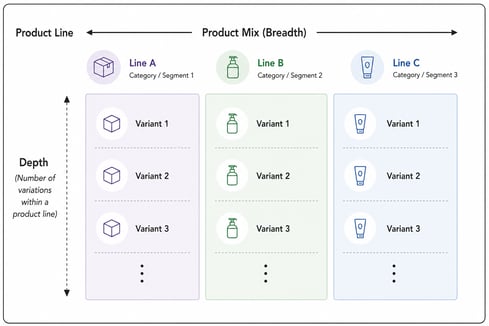
As portfolios grow, Product Managers need to balance breadth, depth, complexity, and commercial value. More products can create growth, but they also increase formulation, packaging, inventory, regulatory, manufacturing, and operational complexity.
Launching a new product line requires greater investment, technology development, and marketing resources, whereas deepening an existing product line requires relatively less investment. Similarly, expanding a product line into a new market demands more market development than product engineering. Changes in regulations, key ingredients, or core components can produce sweeping effects across entire product lines.
Balancing Investment Across the Portfolio
The Three Horizons of Portfolio Growth
A structured way to distribute investment across horizons:
Core — Hero Products
Protect and strengthen products and categories that generate the majority of current business volume and margins. Investment focuses on improving competitiveness, protecting market share, reducing cost, or extending product life.
Adjacent — Margin Drivers
Extend existing capabilities into adjacent opportunities such as new segments, channels, geographies, applications, or related product categories.
Emerging — Trends
Invest selectively in new technologies, categories, business models, or markets that may create future sources of growth.
Types of Portfolio Investment
The portfolio must balance four distinct allocation types:
- Innovation: Creating new products, technologies, or propositions.
- Renovation: Improving, reformulating, or extending existing products.
- Maintenance: Sustaining current offerings and addressing operational needs.
- Compliance-driven change: Adapting products to regulatory, safety, or market-access mandates.
The objective is not to maximize product count, but to maintain the right portfolio balance across current revenue, future growth, risk, and operational complexity.
Strategic Prioritization & Decision-Making
Product Management inevitably involves deciding what not to pursue. Most businesses have more ideas, requests, and opportunities than capital, headcount, or development capacity. Prioritization is therefore a core capital allocation decision, not an administrative exercise.
The 10 Dimensions of Prioritization
- Opportunity attractiveness: How compelling is the market opportunity?
- Strategic alignment: Does it support the overall business, product strategy, and portfolio trajectory?
- Customer value: Does it solve a meaningful problem with a clear value proposition?
- Technical feasibility: Can existing know-how be leveraged with low uncertainty, or does it resolve technical debt?
- Development complexity: Is execution straightforward with synergistic advantages, or does it demand expanding operational capabilities?
- Competitive advantage: Does it offer a distinct, defensible benefit to the customer?
- Investment required: What capital and operational resources are needed through go-to-market?
- Revenue potential: What commercial value could it unlock across specific segments, channels, and regions?
- Risks: Do the potential commercial, technical, regulatory, or operational uncertainties outweigh the upside?
- Time-to-market: How long until launch, and how many quarters until payback is achieved?
Structured Prioritization Frameworks
No framework replaces executive judgment—its purpose is to make that judgment visible, comparable, and repeatable.
Core Decision Heuristic
Attractiveness + Strategic Fit + Customer Value + Feasibility − Risk − Investment Rate
The exact formula matters less than establishing a transparent rationale that every stakeholder understands.
Prioritization must not be driven by the loudest stakeholder, the latest idea, or the single largest customer request. It should reflect agreed strategic criteria and the relative commercial return of competing initiatives.
Continuous Review & Execution
The output must be a clearly ranked portfolio pipeline answering whether to invest, defer, or discontinue initiatives—translating high-level strategy directly into disciplined resource allocation.
Regular product portfolio reviews align products and variants with organizational strategy and form the bedrock of roadmap planning and the NPD pipeline. As portfolio complexity expands, connected product lifecycle systems unify strategy, product data, capital allocation, and day-to-day execution into a cohesive operational rhythm.